


Afternoon report: Corn also in the red on Tuesday, as soybeans fought for modest gains
Grain prices were mixed but mostly lower on Tuesday. Wheat contracts saw the most downside after reaching three-month highs yesterday, which triggered some profit-taking today. Winter wheat prices fell by more than 3%, with spring wheat prices down nearly 2.5%. Corn prices were relatively muted, with losses of around 0.75%. Soybeans failed to gather much forward momentum but did finish the session with fractional gains. Traders next turn their focus on the next World Agricultural Supply and Demand Estimates (WASDE) report from USDA, out tomorrow morning.
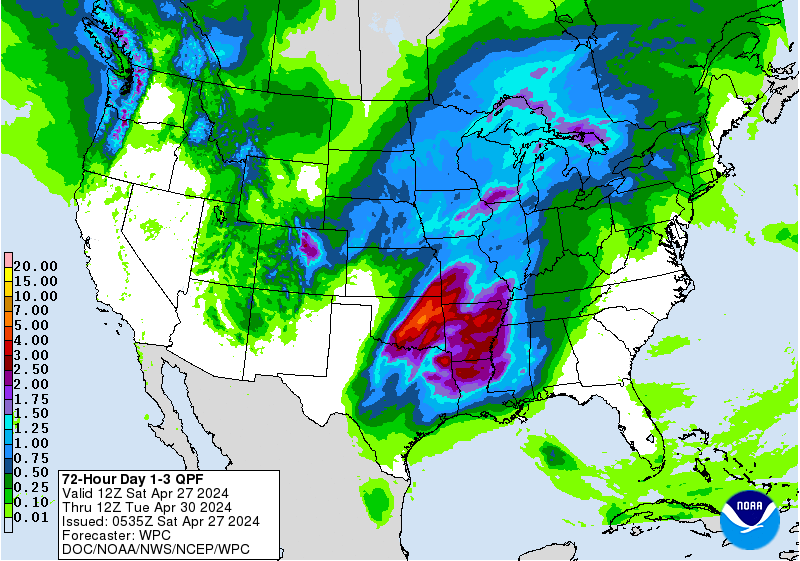
More rain is likely for the eastern Corn Belt between Wednesday and Saturday – in fact, most areas east of the Mississippi River will collect at least some measurable moisture later this week, per NOAA’s latest 72-hour cumulative precipitation map. In contrast, areas farther west will see little to no rain fall during this time. NOAA’s new 8-to-14-day outlook predicts below-normal precipitation for the Northern Plains and upper Midwest between October 18 and October 24, with seasonally cool conditions for the eastern half of the U.S.
On Wall St., the Dow rose 141 points in afternoon trading to 29,344 as it attempts to break up a four-session losing streak. Investors anxiously away the next consumer price index (CPI) updates, out Thursday. CPI is a leading indicator of inflation. Energy futures were mixed but mostly lower. Crude oil dropped 2% to $89 per barrel. Nearby diesel contracts saw small gains, while gasoline spilled moderately lower. The U.S. Dollar softened moderately.
On Monday, commodity funds were net buyers of corn (+11,000), soybeans (+4,500), soymeal (+2,000) and CBOT wheat (+19,500) but were net sellers of soyoil (-1,000).
Corn prices trended moderately lower at traders squared positions ahead of Wednesday morning’s WASDE report and engaged in some technical selling partly spurred by spillover weakness from wheat. December futures dropped 5.25 cents to $6.93, with March futures down 4.75 cents to $7.00.
Corn basis bids were mostly steady to weak across the central U.S. after sliding 1 to 5 cents lower at four Midwestern locations on Tuesday. An Illinois processor bucked the overall trend, firming 5 cents today.
Corn export inspections trended 32% lower from week-ago totals to 18.0 million bushels. That was also on the lower end of trade estimates, which ranged between 15.7 million and 28.5 million bushels. Mexico was the No. 1 destination, with 7.7 million bushels. Cumulative totals for the 2022/23 marketing year are down slightly from last year’s pace so far, with 111.3 million bushels since the beginning of September.
Prior to the next USDA crop progress report, out later this afternoon, analysts think the agency will show corn harvest moving from 20% completion a week ago up to 34% through October 9. Quality ratings are expected to hold steady, with 52% of the crop in good-to-excellent condition through Sunday.
European Union corn imports during the 2022/23 marketing year are more than doubling last year’s pace so far, with 310.2 million bushels through October 9, per the latest data from the European Commission.
Brazil’s Anec estimates that the country’s corn exports will reach 260.4 million bushels in October, which is moderately higher than its prior projection from a week ago.
France’s farm ministry again lowered its forecast for the country’s 2022 corn production to 409.7 million bushels, putting this year’s crop 18.4% below the prior five-year average. The ministry assumed average yields of 121.6 bushels per acre – the lowest per-acre results since 2005.
Taiwan issued an international tender to purchase 2.6 million bushels of animal feed corn, sourced from either the United States, South America or South Africa, that closes on Wednesday. The grain is for shipment between December 5 and January 8, depending on origin.
Preliminary volume estimates were for 219,363 contracts, tracking moderately below Monday’s final count of 331,170.
Soybean prices bucked the overall bearish trend on Tuesday but wasn’t able to gather any sizeable forward momentum today. November and January futures each picked up 0.75 cents to reach $13.7475 and $13.8650, respectively.
Soybean basis bids were mostly steady across the central U.S. on Tuesday but did tilt 7 cents lower at an Ohio elevator and 5 cents higher at an Illinois river terminal today.
Soybean export inspections came in at a healthy 35.6 million bushels after capturing week-over-week gains. That was also toward the higher end of trade estimates that ranged between 14.7 million and 45.9 million bushels. China accounted for more than half of that total, with 25.4 million bushels. Cumulative totals for the 2022/23 marketing year are still moderately behind last year’s pace so far, with 101.4 million bushels.
Ahead of Tuesday afternoon’s crop progress report from USDA, analysts think the agency will show soybean harvest moving from 22% completion a week ago to 41% through October 9. Quality ratings are not expected to change, with 55% of the crop in good-to-excellent condition.
Brazilian oilseed crushing group Abiove slightly raised its estimates for the country’s 2021/22 to 4.666 billion bushels while holding export estimates steady at 2.829 billion bushels. Abiove also slightly raised its Brazilian soymeal production estimates to 37.5 million metric tons and made no changes to its soyoil production forecast of 9.9 MMT.
Meantime, Brazil’s Anec issued a new forecast for the country’s October soybean exports, now at 127.2 million bushels. That’s moderately above the group’s prior estimate from a week ago. Anec also expects Brazilian soymeal exports to reach 2.112 million metric tons this month.
European Union soybean imports during the 2022/23 marketing year reached 114.6 million bushels through October 9, putting it slightly behind last year’s pace so far. EU soymeal imports are also running below last year’s pace, with 4.21 million metric tons during the same period.
China will auction another 18.4 million bushels of its state imported soybean reserves on Friday, per a statement issued today by the country’s National Grain Trade Center. The country has offered a series of similarly sized auctions throughout 2022 in an attempt to boost local supplies and quell high prices.
How are your crops looking this week? Is harvest progressing as planned? Click this link to take the survey and share updates about your farm’s crop development. Farm Futures grain market analyst Jacqueline Holland regularly reviews and uploads results to the FFTF Google MyMap, so farmers can keep current with peer anecdotes from around the country.
Preliminary volume estimates were for 195,557 contracts, which was moderately below Monday’s final count of 288,757.
Wheat prices suffered a big technical setback, proving that volatility in either direction has been fairly common in recent weeks. December Chicago SRW futures lost 36.75 cents to $9.0125, December Kansas City HRW futures dropped 33 cents to $9.9125, and December MGEX spring wheat futures fell 24.75 cents to $9.8950.
Wheat export inspections trended moderately lower than week-ago results to 22.6 million bushels. Still, that was on the higher end of trade guesses that ranged between 13.7 million and 27.6 million bushels. Iraq was the No. 1 destination, with 3.9 million bushels. Cumulative totals for the 2022/23 marketing year are fractionally behind last year’s pace, with 335.5 million bushels.
European Union soft wheat exports during the 2022/23 marketing year have reached 360.5 million bushels through October 9, which is slightly below last year’s pace so far. EU barley exports are sharply lower from a year ago, with 103.3 million bushels over the same period.
Japan issued a regular tender to purchase 3.5 million bushels of food-quality wheat from the United States, Canada and Australia that closes on Thursday. Of the total, 27% is expected to be sourced from the U.S. The grain is for arrival by the end of January.
Preliminary volume estimates were for 105,777 CBOT contracts, trending moderately lower than Monday’s final count of 128,421.
Get our top content delivered right to your inbox. Subscribe to our morning and afternoon newsletters!